Trading vs. Investing
A Tale of Two Mindsets
The different mindsets behind short-term trading and long-term investing.
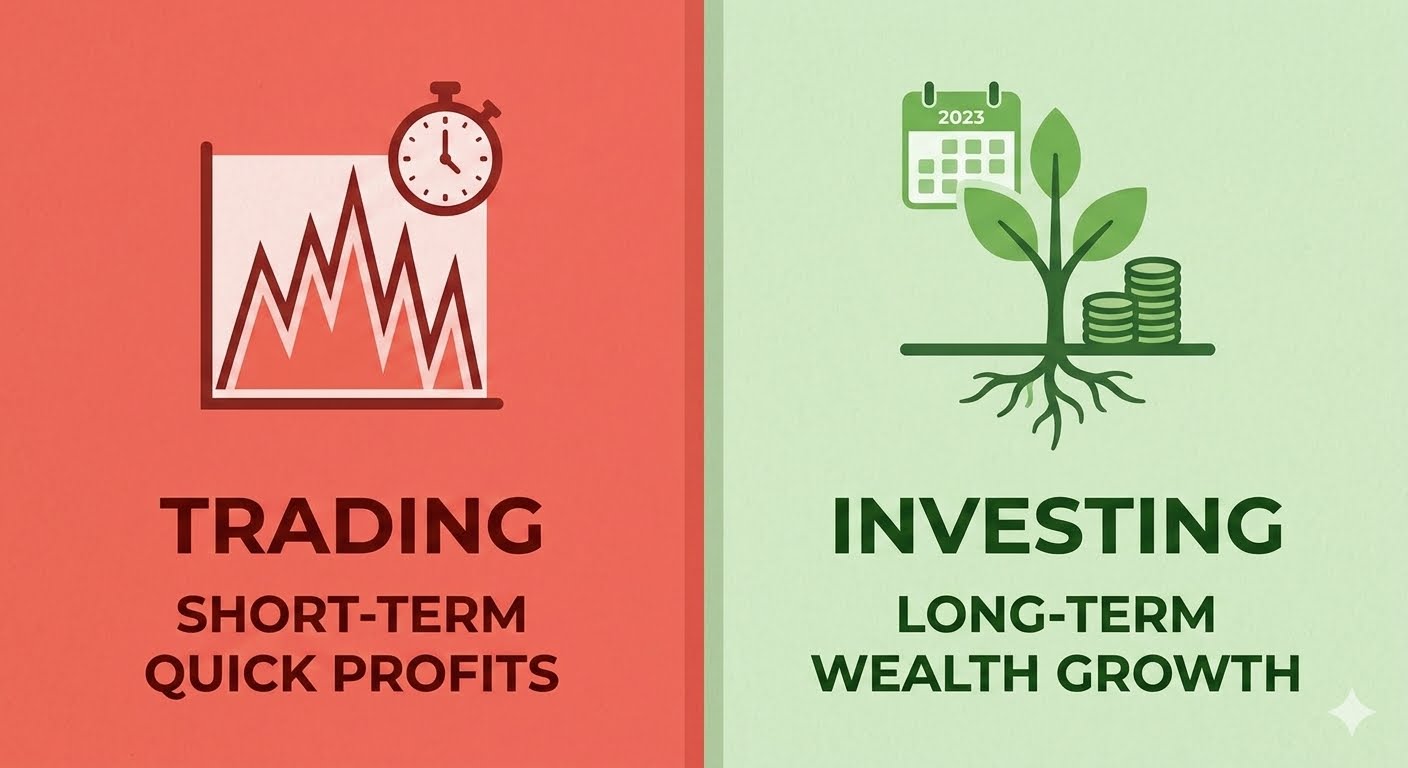
Trading vs. Investing: Two Market Mindsets
People use two main strategies to make money in the stock market: trading and investing. While both aim to grow your money, they use completely different strategies, timelines, and mindsets.
The Trader’s Mindset: Fast Moves and Quick Gains
Traders focus on the short term. They might hold a stock for a few weeks, days, or even minutes. Instead of looking at whether a company is profitable, traders use technical analysis to look at stock charts, price trends, and trading volume to predict where the price will move next.
- Buying Strategy: Traders buy when a stock has strong upward momentum. For example, a trader might buy shares of Apple Inc. (AAPL) simply because the price broke a recent record and looks like it will keep climbing for a few days.
- Selling Strategy: Traders follow strict rules. They set automatic orders to sell immediately if the price drops a little bit (to avoid big losses) or if the price hits a quick profit target.
The Investor’s Mindset: Long-Term Growth
Investors focus on the long term, usually holding stocks for years or decades. They treat a stock like owning a real piece of a business. They use fundamental analysis to look at a company's financial health, profits, and management to see if it will grow over time.
- Buying Strategy: Investors look for good value. They buy a stock when they believe the company has a bright future, even if the general market is having a bad day.
- Selling Strategy: Investors rarely sell. They usually only sell if the company's business permanently breaks down, or if they need the money for a long-term goal like retirement.
The Best of Both Worlds: My 80/20 Strategy
As a beginner, I combine both methods to build a balanced portfolio. My personal approach is putting 80% of my money into safe, long-term investments through broad-market funds like:
- SPDR S&P 500 ETF Trust (SPY) which covers the 500 biggest public companies in the United States.
- Invesco QQQ Trust, Series 1 (QQQ) which focuses heavily on the technology sector and tracks 100 of the largest non-financial companies listed on the Nasdaq stock exchange.
I set aside the remaining 20% of my capital for short-term trading. This hybrid strategy gives me the safety of long-term compounding wealth, while trying to beat the market by trading individual stocks with a small, controlled amount of cash.